
LOCHIEL DIARY

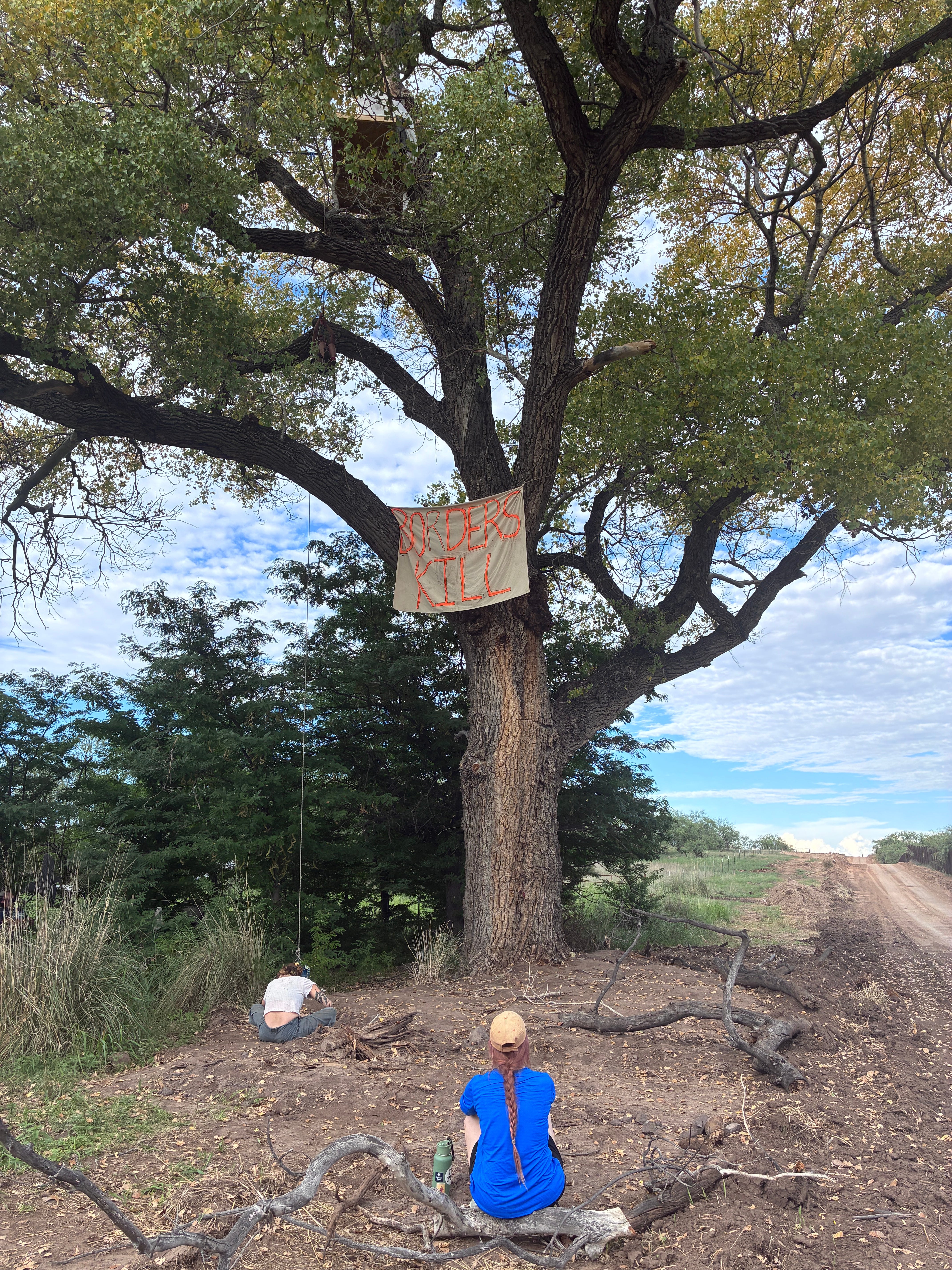
On July 27, triggered by the brutal destruction of several ancient cottonwoods, a protest camp emerged in the San Rafael Valley, near Lochiel, Arizona, along the US/Mexico border. Lochiel isn’t even a town, it’s a place, where tall oaks and cottonwoods stand out in a sea of grasses. This land, a biologically diverse savannah, is a unique environment in Southern Arizona, a watery oasis just eighty-five miles south of Tucson. After a lone protester blocked construction and was arrested, people built a protest camp and a tree sit, halting further construction at the site. The following article chronicles several snapshots of the first two weeks of camp, punctuated by historical reflections on the transformation of the border since NAFTA. The entries capture both the excitement and the still moments that make up the experience of camp time.
Lochiel, Arizona. July 28, 2026.
Mimi and I spent four hours in Lochiel. We arrived after the felling of the first two trees and Logan’s arrest. The third was toppled while we were getting oriented at the former port of entry, closed in 1983. Now we are calling it the Port of Hope.
People have been camping under the trees for more than a month and said they had been able to hold off the destruction until yesterday, when only three people remained. They are on private land with permission of the owner. Crews arrived early in the morning. They began by circling the trees and severing the roots underground before pushing them over. Two of them were closely joined at the root.
Logan was arrested for trespassing by the Santa Cruz County Sheriff, who has spoken out against the border wall. He was released by evening, not charged.
Lochiel is remote, twenty-five miles and an hour from Nogales on mostly unpaved roads. There is a scattering of houses, some of them lived in part-time, none year-round. La Noria on the Mexican side is a handful of rancherías. The agricultural town of Santa Cruz, a municipal seat, lies ten kilometers to the south with a population of roughly one thousand. The Santa Cruz River that borders Tucson has its headwaters just north of the border. It enters Mexico in an oxbow and meanders through the settlement that bears its name to return north. The whole area is green and shady, rich in groundwater, an oasis marked by ribbons of Fremont Cottonwoods through the desert.
I recorded a brief interview with L., who works as a social worker in the Tucson public schools. They told me the two communities are one, Lochiel and La Noria, previously separated only by a vehicle barrier, a few feet off the ground, with a long tradition of families on both sides ignoring the border and jumping the fence to party together. Everyone is against the wall. L. told me they fell in love with a rural Mexican community and could not stay away. They told me about layers of continuous human settlement on the banks of the river. There is a multicomponent archaeological site, one on top of the next, directly in the path of planned destruction. The contractors were tossing aside the markers.
There were questions I meant to ask, but we were interrupted and anxious to go to the site. I wanted to ask who were the tree defenders, for example. It had been more than a month of waiting and watching the wall come closer from both sides. We witnessed the culmination of that initial vigil when nothing seemed to happen.
We walked to the site through overgrown weeds. It is still a grove of tall trees, cottonwoods, mesquites, honey locusts. The four trees were in the Roosevelt Reservation, the strip between Mexico and the private land where we gathered, welcomed by the owner who was somewhere else. There was a handful of people, including two photographers, both with drones. I recognized John Kurc from six years ago when he filmed the destruction of Guadalupe Canyon and sites to the east. They carved through mountains with dynamite to dig canyons where they placed the border wall. His footage was featured in a New Yorker video.
The crew from Fisher Industries went about their business and we went about ours. We watched an excavator pick up shattered limbs and drop them into a dump truck, then we watched another excavator dig at the roots of the last tree, then stop and pile the dirt back into the hole. Someone said they would take it down the next day. From a heavy equipment point of view, it was mesmerizing, watching those giant teeth pick up branches and drop them down.
A branch had fallen into Mexico, we could see where the fence was damaged. The fence is wire mesh, maybe six feet high, on the border itself. A bigger branch had fallen on the landowner’s side and we watched the Fisher crew wind barbed wire around a post that had nothing to stabilize it and then pull the wire tight by hand. Not a fencing crew that.
The other question I didn’t ask was what they thought would happen. The regime had announced plans to begin building there on June 15. People have been rolling through ever since, fifteen to twenty, spending various amounts of time. Did they think they could protect the trees indefinitely, camping in tents? According to the Port of Hope: “The goal is to STOP or SLOW border wall destruction on this area. We try to minimize the harm done by contractors by keeping them accountable and monitor them by filming and documenting them.”
Volunteers arrived overnight from Tucson and are building a platform and planning a tree-sit. I meant to end this by asking, Is witnessing enough? instead I can end by saying, Yes.
***
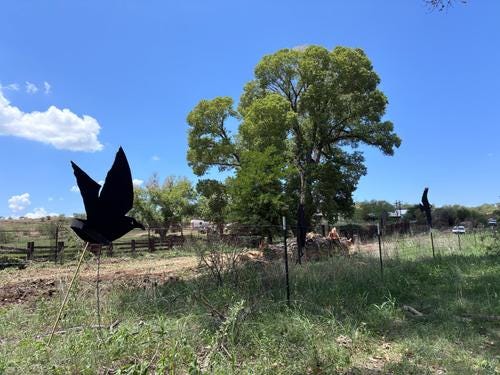
I’ve been thinking about how some kinds of murder weigh more than others—when cops killed George Floyd, we rioted in the streets but the real atrocity of capitalism is the everyday misery and the lengths to which people go to escape it. The real misery is cumulative and invisible, it is gene damage and air and food that poisons while it nourishes. Work that produces nothing good, that diminishes us. Lives shortened by a thousand cuts. Ecocide that proceeds drop by drop, the habitat that shrinks, the toxins that leach out. It is the very fabric of life that we need to oppose, but how.
Then there’s one blow that concentrates all the rage—those immense, ancient trees, smashed when they fell, being hauled away.
(Like the uprooted olive groves of Palestine.)
***
When I moved to Bisbee in 1983 the fire departments in Naco, Arizona and Naco, Sonora fought each other’s fires. They opened the border gates wide and sent emergency vehicles through in both directions. The elementary schools in Patagonia, Arizona and Guaymas, Sonora had a student exchange program. In October, the entire fifth and sixth grades would change places for a week, staying with each other’s families. The Arizona kids would see the sea and the Mexicans got Halloween. The program stopped after 9/11, when Mexican parents were afraid to send their kids to the U.S.
The border marker was a barbed wire fence between towns and chain link between Los Dos Nacos. (The two adjacent towns may have been named for Arizo-NA and Mexi-CO, or maybe not. Naco usually means countrified in a derogatory way.) I took photos which I lost of the fence torn away from its post a block west of the border crossing, leaving room for a small car. People remembered kilos of weed tipped over the wall into their backyards. On Border Road between Bisbee and Highway 80, west of Douglas, the border was five strands of barbed wire. I drove it when I first arrived, incredulous that this was an international boundary, until I saw a Pemex[1] installation, small but labeled such, to the south.
***
Lochiel, Arizona. August 1, 2026.
I went back to Lochiel on the fourth day of the tree sit and watched M. prepare and then ascend. It was their first time and the ascent took maybe four hours. The platform is maybe fifty feet above the ground. There was a handful of us and a Blue Heeler mix named Concha. Two friends from Patagonia, several folks from Tucson. A wildlife photographer who stalks mountain lions. M. asked for poetry, we had a volume of late nineteenth century verse. Someone read Robert Burns, “To a Mouse,” and the lines I’m truly sorry Man’s dominion / Has broken Nature’s social union… We read Blake and probably some Tennyson. It was a hardcover book with a leather-look binding, we admired it. Someone had brought Ursula LeGuin as well. We snacked on cookies, chips, cherries, shared jugs of water and peach tea.
I had come from Tucson. I got up early and looked at the grocery list of requested items from camp, it was all crossed out except for cookies and cigarettes, so that’s what I got. (I also got a white board and markers, and contact lens solution for the tree-sitter, I’m not cheap.) The kids at the smoke shop wanted me to say what kind of American Spirit, then recommended something cheaper. I told them I was supporting a tree-sit against the border wall. When they didn’t react, I dropped it, maybe it was too early in the morning.
I drove to Sonoita on 83 South from I-10, then west to Harshaw Road, just outside Patagonia. These are graded dirt roads and easier than going farther south on the Nogales Highway and getting off on Ruby Road and crossing the Patagonia Mountains. When I arrived, defenders were clustered around one of the fallen trunks and pouring ritual water on its bark, which they offered me, then we walked back to the campsite under the last grandmother cottonwood in the Roosevelt Reservation.
I trimmed some honey locusts that were too close to where we sat; they have three-inch thorns. We talked about restaurants in Sonoita and Patagonia, someone worked at the local wineries. We expressed our appreciation for small towns, where you have to watch what you say but you know who you’re dealing with, usually. We admired Concha, a well-mannered dog, and fed her popcorn. We looked at photos of each other’s cats. We searched for things we lost and found. We had black garbage bags tied in the trees and hand sanitizer. There was a handful of tents and an area under a tarp with jugs of water. We shouted encouragement to M. again and again as they climbed.
A couple from Rio Rico showed up, they heard about it on the Instagram Rally for the Valley. They had been to earlier events and knew the area. We watched a livestock truck inch its way down the roadway on the Sonoran side and wondered if it were picking up or dropping off. It did not seem the right time of year for transporting cattle but what do we know. They were dropping off, I neglected to notice the age of the newcomers while they streamed over the hillside not far away. Sometimes there were horses, nickering.
We talked about how these are the only trees on the border, the only ones to use for a tree-sit, and how inhospitable the border is at Big Bend and Quitobaquito.
We sang for M., badly, You are my sunshine, and endless verses of Goin’ down to the river to pray, substituting for Oh sisters, jaguars, cottonwoods, toads, and so on.
M. made it over the edge of the platform around six in the evening. Two people were spending the night in tents beneath the tree. L. gave me their key so I could feed their guinea pig back in Tucson. We left, I gave a ride to Logan. At first I was grumpy because I did not want to get caught in the dark getting lost with someone I don’t know, but he drove (yes!) and we talked about mines and miners in the West. Clifton–Morenci, so far from anywhere but the Gila Wilderness. He is a wildlife biologist who is doing a bat survey and told me about climbing in old mines and caves. We passed an immense new mine installation near Patagonia, where they are pumping groundwater out of the chamber and it runs across the road. There are dozens of new mines in Arizona alone, dredging out rare minerals to power our cars and devices.
***
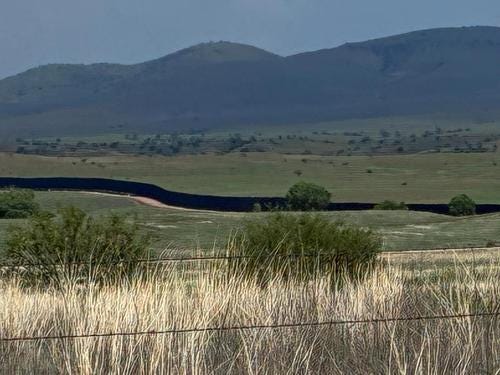
The North American Free Trade Agreement (known as NAFTA) went into effect January 1, 1994, eliminating barriers to market integration between Mexico, Canada, and the U.S. During the years just before, grant money rolled in to border environmentalists. I worked for Arizona Toxics Information as the director’s assistant; I kept books but also directed a survey of pesticide use in two Sonoran communities, one in Fronteras, south of Agua Prieta, and the other in Santa Cruz, a few miles south of Lochiel. We were working closely with an agronomist employed by the State of Sonora, who traveled the state giving advice to farmers in a program similar to county extension services in the U.S. We survived bouts of confusion: the ATI director understood pesticides and inventories but not Mexico; the agronomist knew the farmers and what pesticides they used but had never worked for a U.S. nonprofit; and I knew nothing about pesticides but had lived in rural Mexico and knew nonprofits. We got to Santa Cruz driving west on Mexican Route Two from Cananea. Once we crossed from Lochiel, illegally, risking confiscation of the agronomist’s state vehicle. (It had been closed for more than a decade.) We went past the Port of Hope and lifted a gate, then replaced it. I remembered Santa Cruz being much closer.
Santa Cruz has an immense canopy of cottonwood trees, álamos in Spanish. (Alameda is a walkway lined with cottonwoods.) It was cool and lush. I described it as “heart-breaking beauty” in my report. The farmers convened in a dim and crowded kitchen, they served us Nescafé and pan dulce. There were lace doilies under the dishes in glass front cabinets and family photos and prayer cards and a huge gas stove with a wood-burning component. We handed out surveys and answered questions and they agreed to take part in the inventory for no compensation.
The clinic was in the hands of a medical student from Mexico City doing a hardship rotation, whose nerves had still not recovered from the abrupt change, reversing the long-standing rural–urban migration. She begged us for materials on pesticide poisoning, she had been taught nothing.
The findings of that survey were not surprising: most farmers were using less than recommended doses of herbicides to keep costs down. In response to campaigns against persistent pesticides, many had switched from organchlorine to organophosphate formulas (from DDT to Malathion, for example) which were less persistent in nature but more toxic in their immediate effects, primarily on farmworkers. Sonoran farmworkers had no protection from toxic chemicals, they wore backpack sprayers over t-shirts and jeans. They slept next to stored chemicals. These findings were consistent in the two areas, Santa Cruz and Fronteras.
There were two binational networks during those years, one including Baja, Sonora, Arizona, and California, and the other to the east. People fought hard to include environmental regulations in the final treaty, we did get funding for initial infrastructure such as sewage treatment plants.
The local network had started in the 1970s when people got together to fight the Douglas copper smelter, which once emitted a plume of sulpher dioxide visible in Los Angeles that contributed to acid rain in the Rockies. Visionary environmentalists joined the fight in Douglas to a battle to clean up two nearby smelters in Sonora as air contamination affected the whole region, which we called the Gray Triangle for its smoke.
There was a series of monthly lunches, alternating between the Gadsden Hotel in Douglas and the Hacienda in Agua Prieta, sponsored by the Northeast Sonora–Cochise County Health Council; mayors and city officials attended along with environmental activists and organizers from the neighborhoods. We sponsored bilingual emergency planning meetings and community forums to identify cross-border priorities. For many of us it was a glorious time, we could use our professional capabilities to do something we were passionate about. The Mexican environmentalists of my generation whom I’ve met are former revolutionaries. We believed in organizing the community to defend the environment, in the right to know, in demanding participation, and in acting as if the border did not exist. We worked together for years, we fell in love, traveled together, we thought we were at the beginning of a new era of crossborder cooperation. Many of us are still friends.
Lochiel, Arizona. August 2, 2026.
There was a tree-climbing training session nearby. I went on my way to Bisbee from Tucson, intending to go directly to the training but failed to notice when the directions diverged and I ended up back in Lochiel. I joined the group under the tree for a couple of hours.
The person who was taking M.’s place showed up, she had previous experience. She arrived with a companion who also had experience. He had coincidentally replaced the railing on my deck a few weeks ago and is planning to do more work for me soon. There was a lot of back-and-forth on the walkie-talkies. I watched M. descend. There was a startling moment when she seemed to freefall off the platform and swung in the air. The descent seemed as technical and precise as the ascent, it was slow. I thought about how much of political work is waiting, being a body in a place to show defiance or simple existence. Watching.
I left with L. and stopped to photograph one of the immense trunks lying on its side, a corpse. I followed them to the training, where we threaded our way up a slope and found more than a dozen people on the ground under an immense oak tree with ropes hanging off it.
I’d been told the trainer is a professional climber. He was pleasant, unhurried. I arrived for the sessions on hard and soft gear. Hard gear is carabinier clips, they must be rated for climbing. We passed them around. Soft gear is ropes and straps. I left after an hour.
***
NAFTA removed barriers to commerce and capital but not human labor. Mexico had a practice of strong tariffs to protect domestic manufacturing; these were lifted and cheap goods, including staple crops, flooded the country. Government agricultural and consumer subsidies were lifted. Article 27 of the Constitution had guaranteed land to the landless and created thousands of collective holdings. The Constitution was written while the Revolution raged and this was its central demand. In 1992, Article 27 was reformed to permit the privatization of former communal holdings, in line with the move to privatize public resources and cut back social services. (The Zapatista Revolt was one response.) Hundreds of thousands of campesinos were displaced and many headed for the U.S. The volume of merchandise crossing the border expanded exponentially and so did the contraband coming in with it. The U.S. responded with an enhanced War on Drugs and a campaign to militarize the border. Operations Hold the Line in El Paso and Gatekeeper in San Diego in the 1990s pushed migrants into the low deserts of Arizona. Thousands died of dehydration and exposure; mortuaries were overwhelmed and corpses piled in trailers.
Border walls were erected in place of simple fences. 9/11 accelerated the process in 2001.
When I moved back to Arizona in early 2002, I joined the last volleyball game over the fence in Los Dos Nacos. This was a long tradition that had died out and was revived one last time while a planned border wall came closer. At halftime there was a talent show. A teenage chorus from Naco, Sonora sang “New York, New York,” then an overall-wearing folksinger from Tucson sang “Imagine.” The border patrol lurked within view. As I recall, no one crossed during the event, while someone waited in the wings with his water jug in hand. We shared food and drink across the fence, lowered to the height of a net. Soon there was a wall in its place, of corrugated steel.
Lochiel, Arizona. August 11, 2026.
My fourth visit to the camp started late when I needed to tend to a tire before leaving Tucson. I bought a small, battery-powered pump, and met someone at Costco for a load of supplies, including socks because the rains have started. The roads coming from Sonoita were good, despite heavy downpours. I passed a number of border patrol green-and-whites, all of them moving west.
There is now a well-worn path among the weeds between the Port of Hope and the Grandmother Cottonwood. The meeting place under the tree has expanded, a dozen of us sat in the shade. Someone brought their ten-year-old, who was reading on a tablet, cool kid. Newcomers set up tents. Hot dogs for lunch. A lively discussion of the Partido Liberal Mexicano, Mexican anarchists who associated with the Wobblies and were active in the borderlands.
Meanwhile, an excavator was tearing down the six-foot metal fence on the Mexican side, piling it up and hauling it off. Fisher supervisors walked back and forth with sidearms and Border Patrol drove by. The Army 101st Airborne Division had visited the camp asking questions the week before and a Department of Homeland Security helicopter had buzzed low on two consecutive days. Only a handful of us remained on the ground defending the tree. We were hoping the rains would hold off construction until their usual four-day weekend and that we could mobilize more defenders rapidly.
Lochiel, Arizona. August 13, 2026.
As I write, the tree is still standing and a call for defenders has gone out far and wide. More supporters are arriving every day and the Instagram account, rally.forthevalley, has received hundreds of thousands of new views. We are still here.
[1] Petroleos de México is the state-owned oil and gas company, it is everywhere throughout the country.
thank you habibti!
Really appreciate the diary!